
Challenge Partners Accredited Areas of Excellence at Sudbury Primary School
Challenge Partners QAR Review November 2025
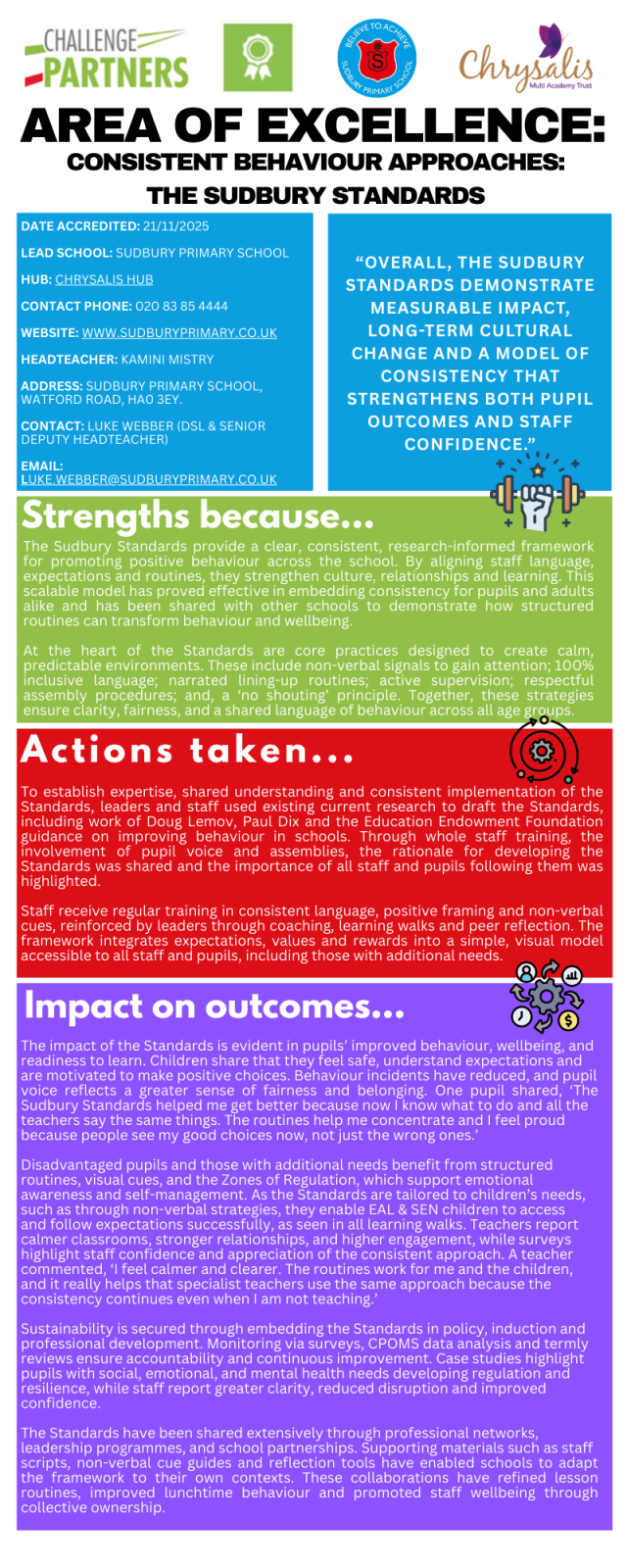
Accredited Area of Excellence:
Consistent Behaviour Approaches: The Sudbury Standards
 What is the name, job title and email address of the staff lead in this area?
Luke Webber
DSL & Senior Deputy Headteacher
luke.webber@sudburyprimary.co.uk
Challenge Partners QAR Review February 2024
Accredited Area of Excellence:
Pioneering Excellence in Primary English and Mathematics Moderation
Why has this area been identified as a strength? What actions has the school taken to establish expertise in this area?
Leaders recognise the pivotal role that moderation has in ensuring consistency and accuracy in assessment practices. They have therefore put in place and embedded robust systems to standardise assessment and moderate throughout the academic year. The English and mathematics leaders have worked closely with the assessment leader to identify criteria for pupils working towards expected (WT), at expected (EXP), and at greater depth (GD) for reading, writing and mathematics, for all year groups in Key Stages 1 and 2. Teachers use these criteria grids to identify when every pupil meets each criterion, and when it becomes embedded. This is dated so that evidence in pupils’ books can be checked and used for moderation purposes. In order to support teachers in accurate assessment, leaders have put together examples of pupils’ work, showing the relevant criteria met and descriptive evidence of why a particular judgement has been made. These have been made into portfolios for teachers in each year group to use in reinforcing or supporting their judgements. Additional progress points have been added where pupils can be ‘working towards +’ and ‘expected +’. Pupils in these categories are part way to achieving expected or greater depth. This system provides additional steps of progress and is used across school to measure progress, alongside attainment. Prior to each of the three annual assessment points, leaders of core subjects share examples of WT, EXP and GD and provide training for teachers prior to them making their teacher assessments using the criteria. Anonymised moderation takes place in year groups or phases at least three times year, so that teachers are confident in their judgements. Teacher assessments then sit alongside test outcomes and any discrepancies are discussed with further evidence. Work of pupils on the cusp of judgements is moderated with phase leaders and/or subject leaders to further ensure consistency. ECTs and any teachers requiring additional support with moderation judgements are provided with this by senior leaders, who work alongside them and model best practice. Consequently, a culture of support and confidence building has been created. At Sudbury, there are six teachers across Key Stage 1 and 2 who are external moderators for Brent Local Authority. They have opportunities to work with the lead moderator for Brent and access training, which further reinforces their moderation judgements. The Talk for Writing consultant also works with school staff on assessment and moderation. School senior leaders have made moderation presentations at Brent Assessment Leaders’ Network, and also at subject leader networks. Other local schools have been invited by Sudbury to participate in moderation for all year groups in Key Stages 1 and 2 and have found the opportunity to be extremely valuable. As one teacher said, ‘We can really see now what is expected, and what is greater depth’.
What evidence is there of the impact on pupils’ outcomes?
Sudbury is in the top 5% of schools nationally for pupil progress. The rigorous and consistent expectation by all teachers for pupils to make at least expected progress from their starting points, and rapid progress where catch up or further challenge is needed, is evident in work seen in pupils’ books. The step progression system that leaders have created ensures that the progress pupils make is closely monitored. Towards the end of each term, following interrogation of test outcomes and teacher assessments, rigorous moderation takes place with colleagues in reading, writing and mathematics. Discussions between teachers and senior leaders then focus on reviewing the aspirational targets set and further increasing challenge and support, where relevant. A rigorous intervention and support strategy is then implemented. Consequently, outcomes at the end of each key stage are above the national average at age-related expectations. This is despite high levels of mobility and significant numbers of pupils joining the school mid-year with little or no English. In 2023, 27% of pupils achieved the higher standard at the end of Key Stage 2 in reading, 34% in mathematics and 13% in writing. This focused strategy, alongside the embedding of a new writing strategy, has enabled writing outcomes at greater depth to increase by 8% since 2022. The end of key stage outcomes are reflected across school, where the same rigorous systems are in place. The progress of disadvantaged pupils is above that of their non-disadvantaged peers in almost all year groups in writing, and pupils with SEND make strong progress from their starting points.
What is the name, job title and email address of the staff lead in this area?
Davita Grafstein
Deputy Headteacher & Assessment Lead
davita.grafstein@sudburyprimary.co.uk
Challenge Partners QAR Review February 2023
Accredited Area of Excellence:
Specialist subject teaching in French, music, computing, and physical education, with links across the curriculum
Why has this area been identified as a strength? What actions has the school taken to establish expertise in this area?
The specialist teaching faculty at Sudbury Primary, overseen by a co-ordinator, incorporates the teaching of French, music, computing and PE. Teaching of these subjects is delivered by specialists in their field. Consequently, their expertise enables knowledgeable sequential planning of these subjects across school, from EYFS to Year 6, based on the National Curriculum. Topics of learning within the specialist subject, for each year group, are expertly planned with sequential learning objectives building to a clear end point. This is then shared with pupils so that they know clearly where their learning is progressing from and to within the topic. Progression mapping also identifies links to prior and future learning which is made explicit to pupils. As each of these subject leaders knows clearly the knowledge and skills pupils need to gain, activities for lessons are well chosen to ensure a love of learning in that subject. One pupil spoken to about this said that they look forward to these lessons which ‘boost your positivity because you have something special to look forward to every week’
Although the planning and teaching are delivered by specialists, the planning strategy follows that of all wider curriculum subjects, so that there is consistency in all subjects across school. As part of the planning process, links with other subjects have been made and included in the curriculum design. For example, the inclusion of cardinal points in computing, linked to geography, and simulating rolling in the mud in Reception PE, linked to their topic on ‘farmyard animals’. Consequently, learning in other subjects is reinforced and effective communication is in place with year group teachers and other subject leaders. The strong provision in these subjects has been recognised through a range of quality marks that have been achieved to the highest standard. The school was the first school in Brent to achieve a distinction in the Association for Physical Education Mark. The Youth Sport Trust Gold Mark, School Games Platinum Mark, Healthy Schools Gold Award, National Online Safety Accreditation and Music Mark reflect the level of expertise of leaders and the impact on learning for pupils. Specialist teachers offer a range of extra-curricular activities at lunchtime and clubs after school. These include, coding, band, choir, French, football, and basketball, to name but a few. Intra-school ‘college’ competitions and inter-school competitions, along with a ‘daily mile’, and mental health workshops, provide a wealth of opportunity which some pupils would not otherwise have. Parents are also invited to participate in healthy lifestyles and online safety workshops. Pupils have links with pen pals in France, and the European Day of Languages and French Day are celebrated. Expertise is shared through subject leader support networks, and professional development delivered to schools across the borough. PE and computing professional development has also been delivered by specialist teachers from Sudbury through the Brent Teaching School Alliance.
What evidence is there of the impact on pupils’ outcomes?
Assessment in wider curriculum subjects at Sudbury is well established and outcomes carefully tracked. Although there are no national comparisons for these subjects, outcomes for every year group, assessed against clear criteria, show high percentages of pupils meeting the expected standard, as a result of quality first provision. This has been sustained, despite the impact of the pandemic since 2018/2019. Sports teams have also, over time, been highly successful in external tournaments. Pupil voice discussions have provided very positive feedback about the provision, as has parental feedback.
What is the name, job title and email address of the staff lead in this area?
Mark Kravetz
Specialist Leader
mark.kravetz@sudburyprimary.co.uk